

Legalize rural buildings standing for 4 years
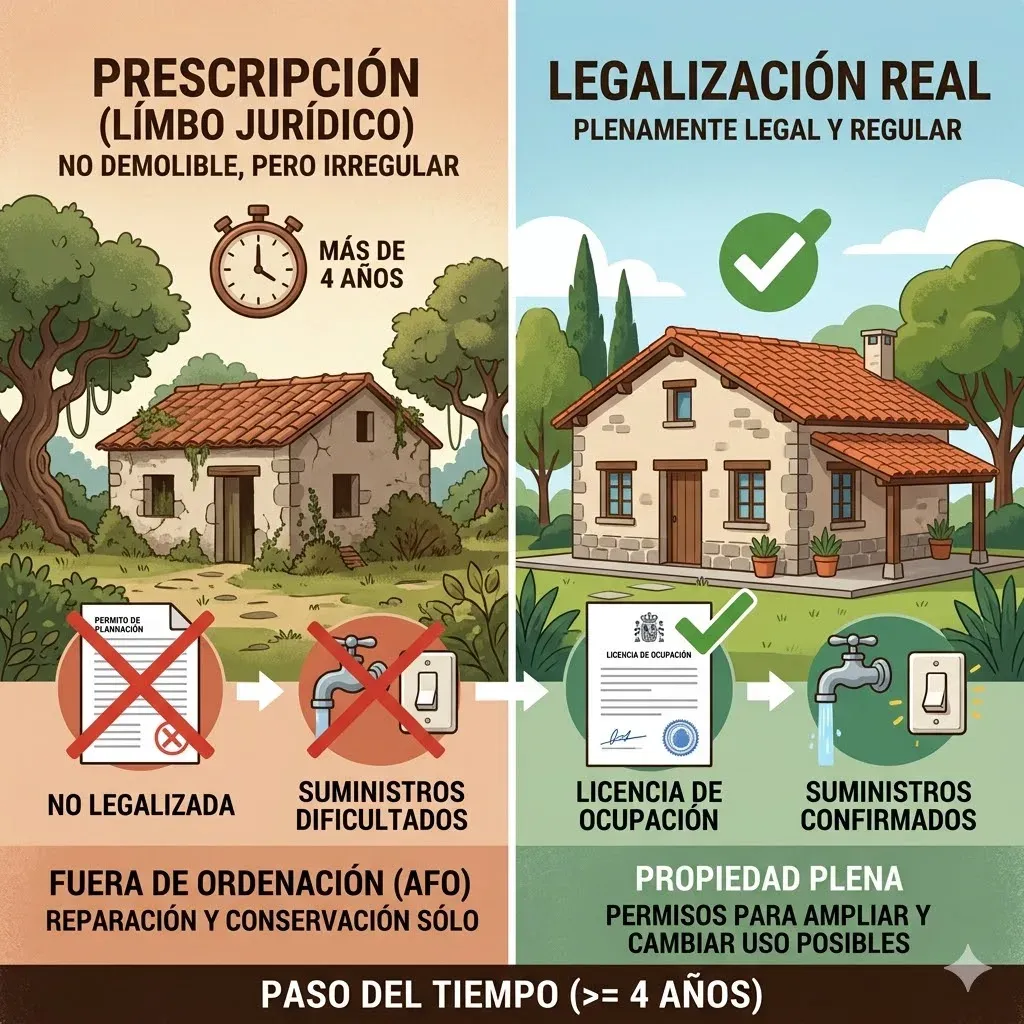
There is a widespread myth in the real estate world: "If you build in the countryside and four years pass without a fine, the house is automatically legal." The reality is much more complex. It is true that a four-year period has historically been the general rule in several Spanish Autonomous Communities for the local town hall's authority to demolish an unauthorized building to expire. However, just because the statute of limitations has passed does not mean the building is legalized.
Below, we break down step-by-step how this process works, the actual difference between "limitation periods" and "legalization," and the requirements to regularize the property.
- The Great Misunderstanding: Statute of Limitations vs. Legalization
It is essential to understand that the passage of time generates two completely different legal statuses:
Statute of Limitations (Asimilado al Régimen de Fuera de Ordenación - AFO): This means that the legal deadline for the Administration to penalize you or force you to demolish the house has expired. The construction remains in a "legal limbo." They will not tear it down, but it remains irregular. Generally, you cannot apply for a license to expand it or change its use, and you may face difficulties securing official water or electricity connections.
True Legalization: This means that the building strictly complies with the local zoning and urban planning regulations of the municipality and the Autonomous Community. By legalizing it, you obtain a first-occupancy license or habitability certificate, making it a fully legal property for all intents and purposes.
Watch out for current deadlines! Although the traditional period was 4 years, many Autonomous Communities have recently extended it to 6, 8, or even 10 years, and in some regions, infractions on common rural land never expire. Furthermore, if the rural land is protected (ecological, landscape, or forestry value), there is no time limit: the administration can order demolition at any time.
- How Do You "Truly" Legalize a Construction Older Than 4 Years?
If your building is on common rural land, the limitation period for your region has passed, and it additionally complies with all local urban development parameters, you can initiate a legalization file. The technical and administrative process requires the following steps:
Hire a Qualified Professional: You will need an architect or technical architect to inspect the property, perform measurements, and verify if legalization is structurally and urbanistically feasible.
Drafting the Legalization Project: The architect will prepare a technical document equivalent to a new-build project but adapted to an already finished structure, which must be officially approved by the Professional College.
Payment of Fees and Taxes: You must pay the town hall the administrative fees for processing the legalization license, alongside the Construction, Installations, and Works Tax (ICIO).
Obtaining the License and Certificate: Once the town hall reviews the project and grants the license, you can apply for the Habitability Certificate or First Occupancy License to secure permanent utility connections.
- What If It Violates Planning Rules But Is Already Protected by Time? (The AFO Regime)
If the house violates urban planning rules but the limitation period has passed, you can register it under the AFO regime (Assimilated to the Out-of-Zoning Regime). You must provide irrefutable proof that construction ended more than four years ago without open disciplinary proceedings. This is done via official aerial photography, technical certificates of age, public deeds, or historical utility bills.